 English


Synthagen Laboratories NL-GHK-Cu in the prevention of commonly occurring diseases such as atherosclerosis, cataracts, diabetes, nephropathy, and Alzheimer’s disease Therapy with the NL-GHK-Cu peptide, thanks to its antioxidant properties, allows for the inhibition and prevention of many pathological processes related to the organ of vision, neurodegenerative diseases, kidney disorders, and cardiovascular conditions.
|
Abstract: Reactive oxygen species (ROS) and reactive nitrogen species (RNS) are free radicals that play an important role in the body, for example by participating in intracellular signaling cascades and host defense against invading pathogens. An imbalance between free radical production and endogenous antioxidant defense may result in cellular oxidative stress, causing oxidative damage to various cellular components such as DNA, proteins, and membrane lipids. Therapy with the NL-GHK-Cu peptide helps restore the balance between free radical production and endogenous antioxidant defense, leading to the inhibition of pathological processes and consequently preventing the development of diseases in the body. Keywords: •NL-GHK-Cu •antioxidation •atherosclerosis •cataract •diabetes •nephropathy •Alzheimer’s disease |
Introduction
Therapy with the NL-GHK-Cu peptide in the preventive treatment of the pathological conditions mentioned in the article title—such as atherosclerosis, cataracts, diabetes, and Alzheimer’s disease—is primarily based on the peptide’s antioxidant defense capabilities. In some of the aforementioned disease cases, other properties of the NL-GHK-Cu peptide also contribute to defining it as a supportive factor in preventive therapy aimed at inhibiting or reducing the risk of diseases of various origins. ANTIOXIDANT DEFENSE OF THE NL-GHK-CU PEPTIDE Free radicals and toxic end products of lipid peroxidation are associated with atherosclerosis, cataracts, diabetes, nephropathy, Alzheimer’s disease, and other serious pathological conditions mainly related to aging. Reactive oxygen species (ROS) and reactive carbonyl species (RCS) are produced in cells in small amounts under physiological conditions and play an important role in cellular signaling and immune defense. A strong antioxidant network maintains the balance between the production and removal of free radicals, resulting in minimal overall damage caused by them. However, during aging and in pathological conditions, this balance may shift toward the accumulation of free radicals, which can lead to oxidative stress and ultimately cell death. NL-GHK-Cu increases the expression of antioxidant genes and inhibits the expression of pro-oxidant genes. It increases the expression of the oxidative/inflammatory gene NF- B as well as the expression of two NF- B inhibitors, TLE and ILBP. In this way, it likely inhibits NF- B protein activity.
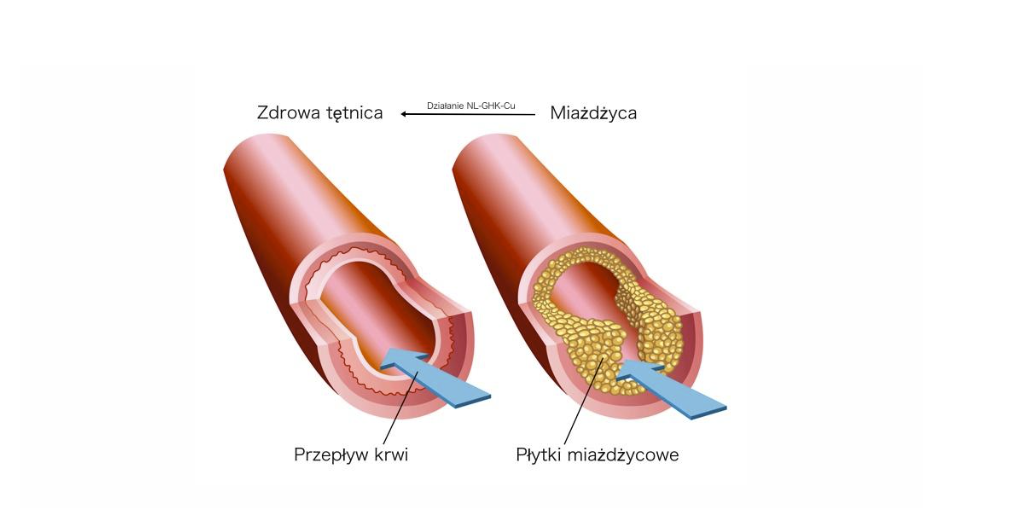
ATHEROSCLEROSIS Atherosclerosis is a progressive arterial disease characterized by the narrowing of the arterial lumen. Arteries, as blood vessels, supply the body with essential oxygen and nutrients. Atherosclerosis may affect arteries leading to various organs, including the heart, brain, and kidneys; consequently, this disease may result in hypoxia of these organs. Atherosclerosis can begin developing as early as childhood and initially progresses without symptoms. Symptoms appear when the artery is narrowed by approximately 50%, which is most often noticeable after the age of 50. The symptoms of atherosclerosis vary and depend on which artery is affected. The most common symptoms include shortness of breath, fatigue, and lower back pain. GHK-CU IN THE PREVENTION OF ATHEROSCLEROSIS The NL-GHK-Cu peptide affects processes occurring in the mitochondria, where its action reduces lipid peroxidation and thus lowers the risk of developing atherosclerosis, as well as alleviates existing symptoms of the disease as a supportive therapy. Another aspect, resulting from modern and innovative research on atherosclerosis, is the effect of the NL-GHK-Cu peptide on the activation of vascular endothelial growth factor (VEGF), whose activation in atherosclerosis has so far been considered a pathological phenomenon. However, at appropriate doses, therapy with NL-GHK-Cu may produce the opposite effect—helping to prevent the occurrence of this disease. New potential treatment methods are being intensively studied. VEGF is the main angiogenic factor controlling vessel growth, vascular homeostasis, permeability, and vasodilation. Therefore, it is considered a potential new therapeutic target for ischemic heart disease and ischemic peripheral vascular disease. Therapy with NL-GHK-Cu also, through its properties, suppresses fibrinogen synthesis. NL-GHK-Cu was isolated as a plasma molecule that suppressed fibrinogen. Fibrinogen is best known for its ability to form blood clots. However, it also significantly affects blood flow in the microcirculation, where blood flows under increased pressure pulses and then returns to a semi-solid gel state. Elevated fibrinogen significantly increases blood viscosity in the microcirculation by promoting the stacking of red blood cells or rouleaux formation. These properties further confirm the ability of the NL-GHK-Cu peptide to inhibit disease processes associated with atherosclerosis.
CATARACT Cataract is a disease of the organ of vision characterized by clouding of the eye lens. It may occur due to injuries or the use of certain medications, such as corticosteroids. The most common type is age-related cataract, whose causes are not fully understood. Cataracts usually occur in older individuals, but they may also affect younger people, for example those with myopia or diabetes. Cataracts may be congenital or acquired. GHK-CU IN THE PREVENTION OF CATARACT As mentioned above, cataract is the clouding of the lens caused by the precipitation of water-insoluble protein compounds formed as a result of oxidation by free radicals. Free radicals are not sufficiently neutralized by antioxidants, whose reserves decrease with age; therefore, it is beneficial to supplement antioxidants through dietary intake. As mentioned earlier, the NL-GHK-Cu peptide increases the expression of antioxidant genes and inhibits the expression of pro-oxidant genes, which prevents and slows the risk of cataract development, both acquired and congenital.
DIABETES Diabetes belongs to a group of metabolic diseases characterized by chronic hyperglycemia resulting from impaired insulin secretion or action. Insufficient insulin secretion and reduced tissue response to insulin impair the complex actions of insulin in target tissues, resulting in disturbances in carbohydrate, lipid, and protein metabolism. A patient may present with both impaired insulin secretion and function. GHK-CU IN THE PREVENTION OF DIABETES Reactive oxygen species can induce cellular changes and influence the development of diabetes and its subsequent complications. The level of oxidative stress in diabetes increases due to the ongoing disease process and disruption of the oxidative/antioxidative balance. Products of protein and lipid peroxidation in diabetic patients are significantly elevated, while antioxidant concentrations are markedly reduced. Changes in the levels of antioxidant enzymes and glutathione in diabetic patients suggest that these indicators may be helpful in diagnosing and predicting disease progression. As mentioned, the GHK-Cu peptide helps maintain oxidative balance and thus contributes to reducing the risk of diabetes development and alleviating its symptoms.
NEPHROPATHY Nephropathy is a kidney disease. It accompanies various disorders. Most often, nephropathic changes are associated with symptoms occurring alongside diabetes. In healthy individuals, there are no protein molecules in the urine. In people with diabetes, over time, filtration disorders and kidney changes occur. Increasing amounts of protein molecules begin to appear in the urine, which is a symptom of nephropathy. GHK-CU IN THE PREVENTION OF NEPHROPATHY Free radicals attack not only the pancreas, stomach, and intestines but also the kidneys, influencing the development of nephropathy. NL-GHK-Cu increases the expression of antioxidant genes and inhibits the expression of pro-oxidant genes. It increases the expression of the oxidative/inflammatory gene, leading to the inhibition of nephropathy progression as well as other kidney-related disorders.
ALZHEIMER’S DISEASE Alzheimer’s disease is neurodegenerative in nature and associated with the gradual loss of nerve cells. It is the most common cause of dementia in older age. The disease develops over many years, causing irreversible changes in the brain that may lead to the inability to function independently. However, it can be delayed through early diagnosis and prompt initiation of treatment, which improves the patient’s quality of life. The early stages of Alzheimer’s disease are often unnoticed; symptoms appear slowly, gradually impairing daily functioning. Early signs are often difficult to verify, as episodes of forgetfulness can also occur in younger individuals. The course of the disease may vary from patient to patient; therefore, it is important to pay attention to all unusual behaviors in elderly individuals. GHK-CU IN THE PREVENTION OF ALZHEIMER’S DISEASE The NL-GHK-Cu peptide, through its action profile, acts as a peptidomimetic inhibitor. This peptide prevents the formation of toxic Aβ oligomers, fibrillar aggregates, and DNA damage. It is a potential therapeutic candidate for alleviating the multifaceted Aβ toxicity in Alzheimer’s disease. Additionally, among compounds with protective effects that may reduce oxidative damage are certain neurotrophic factors, such as brain-derived neurotrophic factor (BDNF). NL-GHK-Cu increases the production of neurotrophic factors. The peptide also stimulates the growth of cultured nerves, and nerve stumps placed in a collagen tube impregnated with NL-GHK-Cu show increased nerve growth factor production. Neurotrophins NT-3 and NT-4 increase under the influence of the peptide, and cell migration into the collagen tube accelerates nerve fiber regeneration. Moreover, NL-GHK-Cu also increases the number of axons and Schwann cell proliferation.
BIBLIOGRAPHY 1.M.Zoughaib,D.Luong,R.Garifullin,D.Gatina,S.Fedosimova,T.Abdullin,Enhanced angiogenic effects of RGD, GHK peptides and copper (II) compositions in synthetic cryogel ECM model. 2021; 120:111660. doi: 10.1016/j.msec.2020.111660. 2.L.Pickart, The human tri-peptide GHK and tissue remodeling. 2008; 19(8):969-88. doi: 10.1163/156856208784909435. 3.T.Chai, Y. Law, F.Wong,S.Kim, Enzyme-Assisted Discovery of Antioxidant Peptides from Edible Marine Invertebrates: A Review. 2017. doi: 10.3390/md1502004 4.L.Pickart,J.Vasquez-Soltero,A.Margolina, The Effect of the Human Peptide GHK on Gene Expression Relevant to Nervous System Function and Cognitive Decline; 2017; 7(2): 20. doi: 10.3390/brainsci7020020


BPC-157 and Musculoskeletal Injuries: What Does the Research Show?
Can Peptides Be Taken Orally? Bioavailability and Oral Peptide Delivery