 English



In the world of sport, every injury represents not only pain but also the risk of losing fitness and competitive standing. This is precisely why peptides that support recovery are attracting growing interest. Thanks to their properties, they accelerate tissue rebuilding, reduce inflammation, and shorten the time needed to return to full fitness. In this article, we will examine how peptides support the sports rehabilitation process, what their mechanisms of action are, and which products perform best in practice.
What are peptides and why are they used in athlete rehabilitation?
Peptides are short chains of amino acids that play a key role in regenerative processes.
They are naturally present in the body and participate in the rebuilding of muscles, tendons, and connective tissues. In supplementation form — particularly with controlled release — they act more quickly and effectively, supporting natural repair processes. It is thanks to them that athletes can shorten their recovery period and return to training sooner. Additionally, peptides demonstrate anti-inflammatory properties, which are invaluable in the case of musculoskeletal injuries. By reducing inflammation, they not only alleviate pain but also enable more intensive rehabilitation. It is worth emphasizing that peptides are highly precise in their action — a specific preparation can be matched to a particular type of injury, which increases the effectiveness of therapy.
What mechanisms of action enable peptides to support recovery?
Peptides activate a range of repair processes at the cellular level.
Their action includes stimulating collagen production, which is responsible for the elasticity and strength of connective tissues — particularly important in the case of tendon or ligament damage. Some peptides, such as BPC-157, also accelerate angiogenesis — the formation of new blood vessels — which is crucial for nourishing and oxygenating damaged structures. Another important aspect is their influence on the mobilization of stem cells, which participate in the regeneration of damaged tissues. Peptides can also inhibit enzymes that degrade the extracellular matrix, protecting muscles and joints from further damage. Finally, many peptides act neuroprotectively, supporting recovery from nerve injuries, which is relevant in cases such as spinal injuries.
Which peptides are most commonly used in athlete therapy?
The most popular peptides used in rehabilitation include:
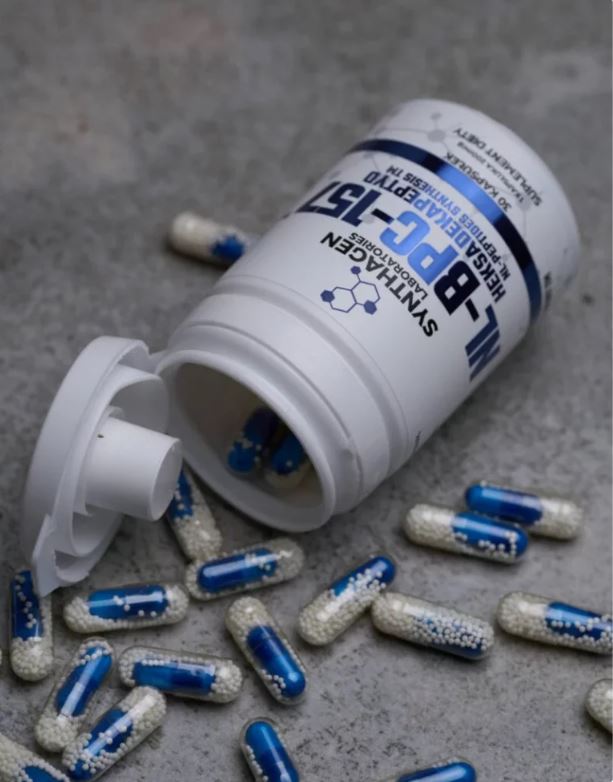
- BPC-157 – regeneration of tendons, ligaments, muscles, and the gastric mucosa
- TB-500 (Thymosin Beta-4) – supports wound healing and improves muscle elasticity
- GHRP-6 and GHRP-2 – increase growth hormone secretion and accelerate rebuilding
- IGF-1 LR3 – regeneration and growth of muscle cells
- GHK-Cu – anti-inflammatory action and rebuilding of skin and soft tissues

Each of these peptides works somewhat differently, which is why their selection should be tailored to the type of injury and the stage of rehabilitation. It is also worth paying attention to the form of administration — extended-release products allow for the maintenance of a stable level of the active substance, which increases the effectiveness of treatment.
What are the benefits of using controlled-release peptides?
Controlled-release products provide stable and effective action without the need for frequent administration. In conventional peptide supplementation, the active substance is quickly degraded or absorbed, which may limit its effectiveness. Modern delivery systems — such as lipid nanoparticles or hydrogels — allow for prolonged therapeutic action and better targeting of the substance. This is particularly significant in rehabilitation, where continuity of action, elimination of concentration fluctuations, and maximization of effects at the site of injury are all critical. Furthermore, this form is often better tolerated and allows the number of applications to be reduced. Research results show that such solutions can shorten recovery time by as much as 30–40%, which is invaluable for professional athletes.
FAQ – Frequently Asked Questions
1. Are peptides safe?
Yes, most peptides used in rehabilitation have a high safety profile, especially when appropriately selected and administered in controlled-release form.2. How long does a peptide treatment course last?
Depending on the type of injury — from a few weeks to several months. Extended-release preparations make it possible to shorten the duration of therapy.3. Can peptides be combined with other rehabilitation methods?
Yes, peptides work excellently alongside physiotherapy, massage, cryotherapy, and manual therapy.Looking for effective peptides to support your rehabilitation?
Browse our offer of controlled-release active ingredients — find the preparation perfectly matched to your needs and accelerate your return to full fitness!


NL-Epithalon in the supportive therapy of obesity treatment
Biological processes behind hair loss