 English


Synthagen Laboratories
In practice, the application of many traditional peptides can be limited by biological instability and rapid degradation. Peptide modification is one approach used to improve the stability and functional characteristics of peptide compounds.
NL-PEPTIDES™ are next-generation peptides developed using specific synthesis and modification processes. Combined with the NL-PEPTIDES DELIVERY™ double-capsule system, the technology has been designed to address some of the challenges associated with peptide stability, gastrointestinal degradation and oral delivery.
List of abbreviations
-
AFP – Pharmaceutically Active Peptides
-
NL-PEPTIDES™ – Next-Generation Peptides
-
NL-PEPTIDES DELIVERY™ – Oral Delivery Technology
Keywords: peptide, peptide bond, peptide analogue, peptide modification, synthesis, salting-out, amidation, acetylation, arginine, oral peptide delivery.
Introduction
Peptides have attracted considerable scientific interest because of their diverse biological functions. However, their practical use may be limited by factors such as biological instability, enzymatic degradation and challenges associated with delivery.
NL-PEPTIDES DELIVERY™ technology was developed as an approach to addressing these challenges. It combines modified peptide analogues with a specialized oral delivery system designed to protect the peptide during its passage through the gastrointestinal tract.
The technology is associated with a protected approach to peptide analogue development and oral peptide delivery.
What Are Traditional Peptides?
From a chemical perspective, peptides are compounds composed of amino acids connected by peptide bonds. Like proteins, they are built from amino acid sequences and have two characteristic ends.
One is the amino terminus (N-terminus), containing an amino acid with a free α-amino group. The other is the carboxyl terminus (C-terminus), containing an amino acid with a free α-carboxyl group.
Peptides perform numerous biological functions. Many hormones and neurotransmitters are peptides, while naturally occurring peptides may also participate in processes associated with cellular communication and defence.
Despite their biological importance, many peptides have limitations related to stability and rapid degradation. For this reason, peptide synthesis and modification are commonly explored as methods of obtaining more stable peptide forms.
The Peptide Bond
A peptide bond is formed when the carbon of an α-carboxyl group binds to the nitrogen of an α-amino group.
During the formation of this bond, the participating amino acids lose molecular fragments: an –OH group from the carboxyl group and an –H from the amino group. Amino acids incorporated into peptides and proteins are therefore referred to as amino acid residues.
The peptide bond has partial double-bond characteristics, which restrict rotation and contribute to the structural properties of peptide chains.
Peptide Synthesis
Different synthesis methods can be used depending on the peptide that needs to be produced.
For relatively small peptides, synthesis involves activating the carboxyl group of an amino acid and progressively forming peptide bonds between amino acid residues.
The synthesis of larger peptides is more complex. Protecting groups are removed and additional protected amino acids are successively attached until the intended peptide sequence has been obtained.
One widely recognised approach is solid-phase peptide synthesis, associated with the Merrifield method. In this method, the C-terminal amino acid is attached to a solid polymer support, and subsequent amino acids are progressively coupled until the desired chain length is achieved.
Peptide Analogues
One strategy for addressing the instability of traditional peptides is the development of peptide analogues.
Peptide analogues are compounds in which selected structural elements of the parent peptide are modified while the key peptide framework is retained. These modifications can influence characteristics such as stability, conformation and biological behaviour.
Different approaches include modifications designed to stabilise α-helical structures, β-turns and β-sheets, as well as the use of D-amino acids or other modified amino acid residues.
The objective of these modifications is generally to obtain peptide compounds with improved physicochemical or metabolic characteristics.
Peptide Analogues Through Modification
Traditional peptides offer many useful biological properties, but they can also present limitations related to stability and delivery.
For this reason, peptide analogues may be created by modifying the peptide chain or selected amino acid side chains while preserving the sequence responsible for the peptide's intended characteristics.
Common peptide modifications include:
-
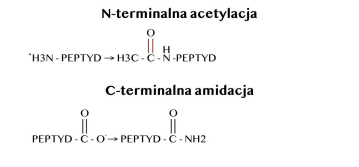
N-terminal acetylation
-
C-terminal amidation
-
Cyclisation
-
Incorporation of D-amino acids
-
Fluorophore labelling
-
Other structural modifications
Acetylation and amidation are among the approaches investigated for improving peptide stability and modifying molecular behaviour.
The Peptide Salting-Out Process
Salting-out is a physicochemical process involving changes in protein or peptide solubility caused by the presence of salts.
The interaction between charged groups and salt ions can influence hydration and molecular behaviour. Depending on the conditions, this may result in precipitation, while the process can often be reversed by reducing or removing the salt concentration.
Within the NL-PEPTIDES™ approach, arginine is used as part of the peptide modification strategy designed to support peptide stability.
Acetylation and Amidation of Peptides
N-terminal acetylation involves the addition of an acetyl group to the amino terminus of a peptide or protein.
In biological systems, acetyl groups may be transferred by enzymes such as N-acetyltransferases, with acetyl-CoA acting as an acetyl donor.
Amidation represents another modification used in peptide chemistry. Both acetylation and amidation can influence peptide stability, charge and molecular characteristics.
Because degradation of peptide chains can occur through several chemical and enzymatic mechanisms, such modifications are frequently studied when designing peptide analogues with altered stability profiles.
What Are NL-PEPTIDES™?
NL-PEPTIDES™ are a group of next-generation peptide analogues developed in response to challenges associated with peptide stability and oral delivery.
The approach focuses on modifying the peptide structure to improve its resistance to environmental conditions that can affect traditional peptides, including changes in pH and temperature.
The technology is intended to help preserve peptide integrity during storage and during passage through the gastrointestinal environment.
Formation of NL-PEPTIDES™ Through Synthesis
NL-PEPTIDES™ are produced through a combination of peptide synthesis and structural modification.
The process incorporates an arginine-based approach together with N-terminal acetylation and C-terminal amidation.
These modifications are designed to improve the physicochemical and metabolic stability of the resulting peptide analogue.
NL-PEPTIDES DELIVERY™ Technology
Developing an oral peptide delivery system involves several challenges.
A peptide must first remain stable during storage and then pass through the gastrointestinal tract, where changes in pH and the presence of digestive enzymes can affect its structure.
NL-PEPTIDES DELIVERY™ technology was developed to combine peptide modification with a delivery system designed to protect the peptide during this process.
The system focuses on three primary challenges:
-
Protecting the peptide during passage through the stomach.
-
Reducing peptide degradation in the intestinal environment.
-
Supporting peptide transport and absorption in the small intestine.
How NL-PEPTIDES DELIVERY™ Technology Works
The NL-PEPTIDES DELIVERY™ system uses a specially designed double-capsule structure.
The outer protective layer is intended to help protect the contents from changes in pH and exposure to gastric conditions during passage through the digestive system.
Once the capsule reaches the intended intestinal environment, its components are released in stages.
The formulation incorporates components intended to reduce proteolytic degradation and support conditions suitable for peptide delivery.
An absorption-supporting component is also included as part of the delivery strategy.
Separating different formulation components within the capsule-within-a-capsule structure is intended to maintain product stability during storage while allowing the components to be released at appropriate stages of digestion.
NL-PEPTIDES DELIVERY™ in the Digestive System
Next-generation peptides produced using NL-PEPTIDES™ technology are incorporated into the double-capsule delivery system.
Following oral administration, the capsule is designed to pass through the upper gastrointestinal tract before releasing its components in the small intestine.
The formulation then releases components intended to create suitable local conditions for peptide delivery, followed by the peptide and absorption-supporting ingredients.
This staged approach is intended to address several of the challenges typically associated with oral peptide administration.
Evaluation of NL-PEPTIDES DELIVERY™ Technology
The technology has been evaluated by comparing oral delivery using the double-capsule system with nasal peptide delivery.
In the referenced comparison, the same peptide doses were used for both delivery methods. Higher measured peptide concentrations were reported following administration using the oral double-capsule system under the evaluated conditions.
These observations formed part of the development and evaluation of the NL-PEPTIDES DELIVERY™ approach.
The Result of Synthagen Laboratories' Work
The development of NL-PEPTIDES DELIVERY™ focused on combining peptide modification with a specialised oral delivery system.
Rather than relying solely on changes to the peptide structure, the approach also considers the conditions the peptide encounters from administration through intestinal delivery.
The resulting technology combines:
-
next-generation peptide synthesis;
-
peptide modification;
-
protection against gastrointestinal conditions;
-
a double-capsule delivery system; and
-
a staged approach to intestinal peptide delivery.
A visual explanation of the technology and its individual stages is also available in the accompanying presentation presentation.


BPC-157 and Musculoskeletal Injuries: What Does the Research Show?
Can Peptides Be Taken Orally? Bioavailability and Oral Peptide Delivery