 English


NL-Epithalon peptide therapy, thanks to the complex profile of action described in the article below, enables processes through which mesenchymal stem cells are stimulated, which in turn allows for maintaining proper dentition and eliminating related problems, as well as serving as an adjunct therapy supporting dental treatment.
|
Summary: Human teeth exhibit characteristics of omnivorous dentition, as they possess features typical of both herbivorous and carnivorous animals. Individual human teeth differ in shape and size, reflecting their adaptation to the mechanical processing of different types of food. NL-Epithalon peptide therapy allows for maintaining proper dentition, as a therapy that helps restore its normal condition, and as a supportive therapy enabling complex dental treatment in pathological conditions. Keywords: •NL–Epithalon • tooth structure • tooth functions • dental formula • types of teeth • incisors • canines • premolars • molars • dental diseases • inflammation • caries • hypersensitivity • NL-Epithalon therapy |
Introduction
In humans, as in other higher mammals, the first dentition consists of so-called primary (milk) teeth. Usually between the ages of five and eight, 20 primary teeth are replaced by 32 permanent teeth. In full permanent dentition, each dental arch contains four incisors, two canines, four premolars, and six permanent molars. The arrangement of teeth in the dental arch is described by the so-called dental formula, in which numbers represent individual types of teeth in half of each of the two dental arches. Unfortunately, human teeth, like any part of the body, can become damaged and weakened. According to studies, modern NL-Epithalon peptide therapy allows for maintaining proper dentition, as a therapy restoring its proper condition and as a supportive therapy enabling complex dental treatment in pathological conditions.
TOOTH STRUCTURE
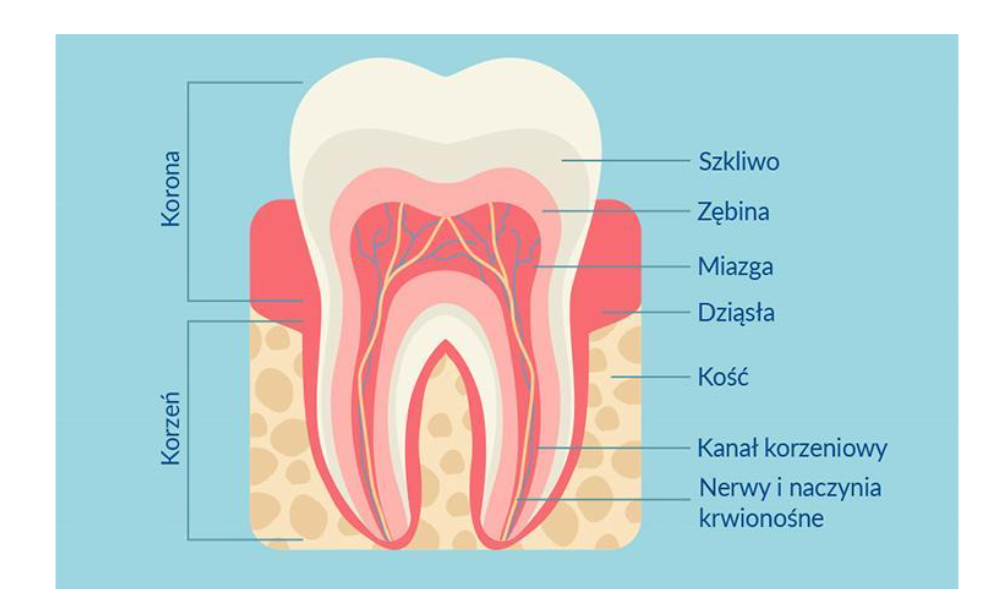
Each human tooth consists of a crown, neck, and root. The first mentioned element, the crown, is externally covered with enamel, which contains mineral salts that give the enamel very high durability and strength. Beneath the enamel lies a layer called dentin. Between the crown and the root there is the tooth neck, covered by the gum. The interior of the tooth is a pulp-filled chamber, which continues into the root canal ending at the apical foramen. The pulp is the only living tissue of the tooth, richly supplied with blood vessels and nerves. The root and neck of the tooth, unlike the crown, are not covered with enamel but with cementum, also known as cement. Beneath the cement layer is dentin, which connects with the crown dentin.
TOOTH FUNCTIONS
Functional differences mainly depend on their structure, which is referred to as heterodonty. In heterodont dentition, each type of tooth performs a different function and has a characteristic shape. Incisors, with a crown resembling a chisel, are involved in biting off pieces of food. Canines, with a conical crown ending in a sharp tip, are used for holding and tearing food. Premolars have crowns equipped with two cusps, while molars have a quadrangular shape with four or five cusps. The function of premolars and molars is grinding and crushing food.
TYPES OF TEETH
In permanent human dentition, four types of teeth are distinguished: canines, incisors, molars, and premolars.
Incisors: thin and flat teeth whose role is to bite off food. Additionally, this type of teeth influences proper speech and the shape of the lips’ outer contour.
Canines: the longest type of teeth, cone-shaped. They are used to tear and break down food, and their positioning and shape directly influence the corners of the mouth.
Premolars: square-shaped teeth used for grinding and influencing the shape of the cheeks.
Molars: the largest human teeth, located deepest in the sockets and having the most root canals. They are responsible not only for grinding but also crushing food.
MOST COMMON DENTAL DISEASES
Tooth abscess
A tooth abscess occurs when a dental infection (e.g., in an untreated tooth) spreads up the tooth pulp and settles in the root near the jawbone, forming a swelling—an area filled with pus. An untreated abscess may lead to serious consequences involving infections of the jawbone or other tissues.
Tooth decay (caries)
Caries is mainly associated with poor oral hygiene or an improper diet that allows bacteria in the mouth to proliferate. Acids produced by their metabolism damage the protective barrier of teeth—enamel. This allows bacteria to penetrate deeper into the pulp and gradually destroy the tooth. Small cavities caused by caries increase over time, resulting in severe pain. Early-stage caries is reversible. Untreated caries leads to problems not only in the oral cavity but also throughout the body and may contribute to serious issues involving the heart, lungs, or kidneys.
Dry socket
Dry socket is a condition that may occur after tooth extraction if the blood clot that normally fills the socket is dislodged. It leaves exposed nerves, causing severe pain and discomfort.
Gingivitis
One of the first symptoms of gingivitis is bleeding during brushing or flossing. If left untreated, inflammation worsens: gums become more red, painful to touch, make eating difficult, and may become swollen. Purulent discharge may also occur.
Temporomandibular joint disorders
Temporomandibular joint (TMJ) disorders affect the jaw joint and associated muscles. Arthritis or structural problems can cause TMJ dysfunction. It may also be a symptom of other conditions such as chronic fatigue syndrome, fibromyalgia, or stress.
Tooth hypersensitivity
Tooth hypersensitivity is an increasingly common condition involving dental degeneration. Individuals experience sharp, sudden pain when consuming hot, cold, sweet, or acidic foods. It occurs in people with exposed dentin, a highly innervated tissue located beneath enamel.
Acid enamel erosion
Acid enamel erosion is primarily caused by an improper diet with frequent exposure to acids found in carbonated drinks or alcohol. Early symptoms include sensitivity when consuming hot or cold foods and beverages, which may be mistaken for general hypersensitivity.
Bad breath
During dental problems of any severity, purulent discharge may occur, leading to unpleasant breath odor, which is both physically and psychologically uncomfortable.
NL-EPITHALON PEPTIDE THERAPY FOR DENTAL AND GUM CONDITIONS
Oral tissues are considered an easily accessible source of mesenchymal stem cells (MSCs). Six different adult human dental stem cell types have been identified in the oral cavity. Oral-derived MSCs, especially human gingival mesenchymal stem cells (hGMSCs), are widely used in regenerative cell therapy to enhance osteogenic processes. This is what NL-Epithalon stimulates. Through the action of NL-Epithalon, the activity of FABP4 is increased, known as an intracellular lipid chaperone regulating lipid transport and cellular responses, as well as PPARγ, which is critically involved in regulating numerous genes responsible for energy homeostasis, glucose and lipoprotein metabolism, de novo lipogenesis, fatty acid uptake, oxidation, storage and export, cell proliferation, inflammation, and vascular tissue function. In this case, it leads to the inhibition of inflammatory dental conditions. Additionally, this indicates that NL-Epithalon peptide therapy is a supportive treatment in complex dental care, enabling faster regeneration.
NL-EPITHALON IN THE PREVENTION OF PROPER DENTITION
NL-Epithalon peptide therapy not only helps eliminate inflammatory processes in the gums and oral cavity but also shows preventive effects in maintaining proper dentition, due to its properties that enhance calcium and phosphorus absorption with regular and long-term use.
BIBLIOGRAPHY
1. Khavinson V, Diomede F, Mironova E, et al. AEDG Peptide (Epitalon) Stimulates Gene Expression and Protein Synthesis during Neurogenesis: Possible Epigenetic Mechanism. Molecules. 2020;25(3):609. Published 2020 Jan 30. doi:10.3390/molecules25030609



Injuries in powerlifting
BPC-157 in the gastrointestinal tract. Cytoprotective effects of BPC-157 in diseases of the stomach, intestines, and liver.