 English


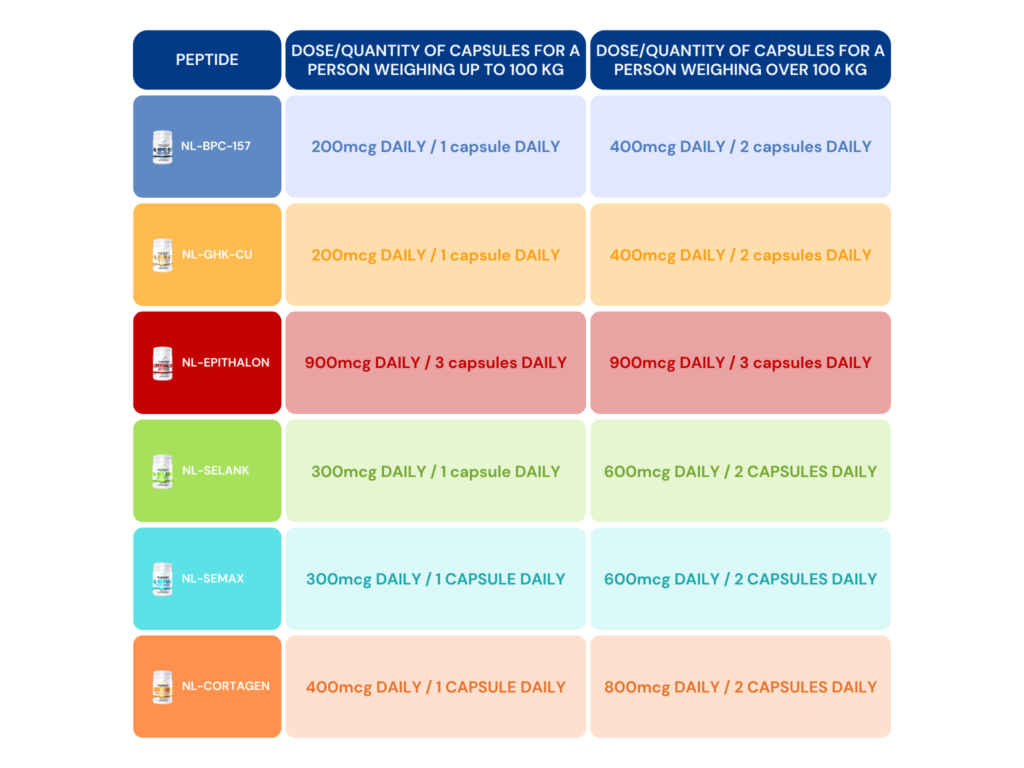
Interest in peptides has grown significantly in recent years, both in scientific research and in discussions surrounding health, metabolism, regeneration and cellular processes.
One of the most common questions concerns peptide dosage. However, determining an appropriate amount is more complex than simply choosing a dose based on body weight.
Different peptides have different biological characteristics, and factors such as formulation, route of administration, individual physiology and the available scientific evidence can all influence how a peptide is studied.
It is therefore important to distinguish between experimental research protocols and clinically established recommendations.
Does peptide dosage depend on body weight?
Body weight can influence the distribution and metabolism of many substances in the human body. For this reason, researchers may consider body mass when designing certain scientific studies.
However, this does not mean that peptide dosage can automatically be calculated using a simple weight-based formula.
Other factors may also be relevant, including:
- the specific peptide being studied;
- its molecular structure;
- formulation and route of administration;
- absorption and bioavailability;
- individual metabolism;
- age and general health;
- the purpose and design of the research.
For many experimental peptides, sufficient clinical evidence is not available to establish universally accepted dosing recommendations.
Why peptide dosing cannot be generalized
Peptides are a broad group of molecules, and individual peptides may behave very differently in the body.
For example, BPC-157, GHK-Cu, Epithalon, Selank and Semax are distinct compounds that have been investigated in different areas of research.
Results obtained for one peptide cannot automatically be applied to another.
Similarly, findings from laboratory or animal studies should not be interpreted as established dosing guidance for humans.
Preventive use of peptides: what does the evidence show?
Some peptides are discussed online in connection with prevention, recovery, healthy ageing or general wellbeing.
However, scientific interest in these areas does not necessarily mean that preventive effects have been clinically proven.
For experimental peptides, available evidence may come primarily from:
- laboratory studies;
- animal models;
- mechanistic research;
- small or preliminary human studies.
More high-quality clinical research is often needed before clear conclusions can be made regarding effectiveness, safety or appropriate dosage.
Peptides and regenerative research
Peptides such as BPC-157 and GHK-Cu have attracted scientific interest because of their potential involvement in biological processes associated with tissue signalling, repair mechanisms and cellular activity.
However, research findings should be interpreted carefully.
Evidence from experimental models does not automatically confirm that a particular peptide can treat injuries, skin conditions or other health problems in humans.
The role of these compounds continues to be investigated.
Peptides and cognitive research
Other peptides, including Selank, Semax and Epithalon, have been investigated in relation to neurological, cognitive and ageing-related processes.
Research in these areas remains evolving.
Studies may explore mechanisms associated with:
- neuronal signalling;
- stress responses;
- cognitive processes;
- cellular ageing;
- oxidative stress.
These areas of research are scientifically interesting, but they should not be interpreted as proof that these compounds can prevent or treat neurological or age-related diseases.
Does the timing of peptide intake matter?
Timing is another subject frequently discussed in relation to peptides.
In scientific research, timing may depend on factors such as:
- the compound being studied;
- formulation;
- absorption characteristics;
- study protocol;
- food intake;
- route of administration.
Some substances may be absorbed differently when taken with or without food.
However, there is no single universal rule that applies to every peptide.
Specific timing recommendations should therefore be based on reliable scientific evidence and the characteristics of the individual compound.
Can peptides be used continuously?
The duration of peptide use varies considerably depending on the compound and the context in which it is being studied.
It is not scientifically appropriate to assume that all peptides can be used indefinitely.
Long-term safety data are limited for many experimental peptides, and continuous use has not necessarily been evaluated in well-designed clinical trials.
Research protocols may therefore involve specific durations, monitoring periods and follow-up assessments.
Why research quality matters
When evaluating information about peptide dosage, it is important to consider the type of evidence supporting the claim.
Scientific evidence generally progresses through several stages:
- laboratory research;
- animal studies;
- early human studies;
- controlled clinical trials;
- larger clinical evidence and long-term safety evaluation.
A dosage used in an experimental study should not automatically be interpreted as a general recommendation for everyday use.
Peptide dosage and individual variability
Individual responses to biological compounds can vary significantly.
Possible influencing factors include:
- body weight and body composition;
- metabolism;
- age;
- genetics;
- underlying health conditions;
- other medications or supplements;
- absorption and bioavailability.
For this reason, generalized dosing tables can oversimplify a complex biological process.
Conclusion
Peptide dosage is a complex topic that cannot be reduced to a single universal formula.
Body weight may be one factor considered in scientific research, but it is only one of many variables that can influence how a peptide behaves in the body.
For many experimental peptides, including BPC-157, Selank, Semax, Epithalon and related compounds, clinical evidence regarding optimal dosage, long-term safety and effectiveness remains limited or continues to evolve.
For this reason, dosage information should be interpreted in the context of scientific research rather than as universal therapeutic guidance.
As peptide research develops, further clinical studies may provide a clearer understanding of appropriate dosing strategies, biological effects and long-term safety.


BPC-157 and Regenerative Processes: What Does the Research Show?
Dosis de péptidos: qué factores se estudian y qué dice la investigación