English



Proactive health
With age, connective tissue regenerates more slowly. For people who want to stay active for decades to come.

Food supplements should not be used as a substitute for a varied diet.
Home / NL Peptides / NL-BPC-157™
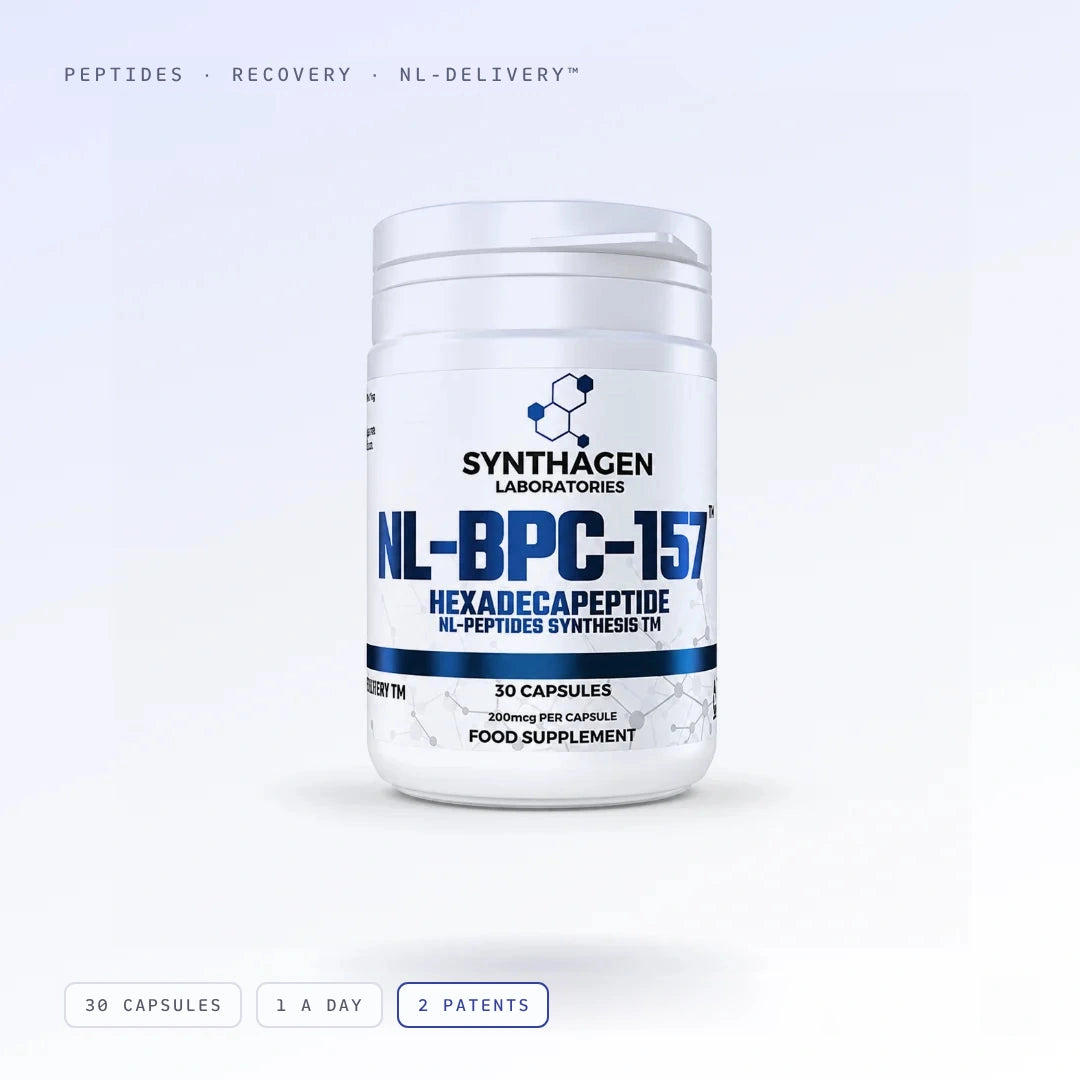


An N-acetylated and amidated analog of the BPC-157 peptide, encased in an NL-DELIVERY™ double capsule.An N-acetylated and amidated analog of the BPC-157 peptide, encased in an NL-DELIVERY™ double capsule. BPC-157 is a fragment of a protein found in human gastric juice and has been studied for over 30 years in relation to tissue repair processes.
Proprietary NL-PEPTIDES™ technology. A special modification of the peptide’s ends that helps protect it from breakdown by enzymes.
Proprietary NL-DELIVERY™ technology. A “capsule-in-capsule” design that helps protect the peptide from stomach acid and other digestive processes.
200 µg of active ingredient per capsule. The formula was developed to limit degradation of the active ingredient and deliver it in unchanged form.
Two international patents. Every batch tested in laboratories in Poland, Germany and Switzerland.
One-time purchase · Secure online payments
“Good morning. I have been using this product for a long time. When I found this company and tried their product, I...”
“Great product.”
“Helps with my joint pain, and make my guts feel better.”
Shipping: orders processed within 24 hours, delivery cost shown in the cart (shipping policy) · Contact: [email protected]
Food supplements should not be used as a substitute for a varied diet. For adults only. Do not exceed the recommended daily dose. Do not use during pregnancy or breastfeeding. People taking medication or living with a chronic condition should consult a doctor before use.
BPC-157 is one of the best-described peptides in preclinical research. We show what it has been studied for, and we’re honest about what isn’t known yet.
In animal models of ligament and muscle–tendon junction injuries, researchers observed improvements in the organization of healing tissue, its mechanical properties and motor function.
In laboratory studies on rat tendon cells, researchers observed increased migration of fibroblasts, the cells that produce the components of connective tissue. These cells also showed greater survival under oxidative stress.
In cell and animal studies, BPC-157 influenced pathways linked to the formation of blood vessels. In a rat model of muscle ischemia, improved blood flow was observed.
More efficient healing after injury, restored strength in damaged structures and improved motor function. These are directions of preclinical research, not confirmed benefits of using NL-BPC-157 in humans.
Results of BPC-157 research cannot automatically be applied to its modified analog or to a finished oral product.
Stomach: four directions of preclinical research on protecting the mucosa and how it repairs.
Why this direction matters: the potential to limit initial tissue damage and preserve a larger area of normally functioning mucosa. This is a preclinical observation, not proof that the stomach is protected during medication use in humans.
One line of research examines whether BPC-157 can limit the extent of mucosal damage after exposure to a damaging agent. Studies in rats analyzed, among other things, stomach damage caused by indomethacin, a non-steroidal anti-inflammatory drug (NSAID), as well as experimental ulcer models. Under some of the tested conditions, a smaller area of lesions was observed after BPC-157 administration than in the control groups.
Why this direction matters: assessing whether the peptide can influence the actual rebuilding of damaged mucosa. Such studies measure changes in tissue, which is not the same as confirming relief from pain, burning or nausea in humans.
Protecting the mucosa also includes its ability to repair itself. Once damage occurs, cells must rebuild the epithelial surface, and the deeper tissues must form a base that allows healing. In a rat model of chronic ulcer, BPC-157 administration was followed by a smaller ulcer area, rebuilding of the glandular epithelium and formation of granulation tissue, a tissue involved in healing.
Why this direction matters: testing whether improved vascular conditions can support cell survival and the rebuilding of damaged tissue. The exact mechanism of action of BPC-157 is still being investigated.
Mucosal repair requires a supply of oxygen and nutrients. That’s why researchers also analyze the effect of BPC-157 on vascular mechanisms and angiogenesis, the formation of new blood vessels. In a rat model of ulcer recurrence associated with clopidogrel administration, changes were observed in markers related to blood vessel formation and the nitric oxide system. The results suggested that these processes play a role in the protective effect observed.
Why this direction matters: the potential to limit secondary damage to the mucosa and preserve the cells needed to rebuild it. The results do not establish BPC-157 as a treatment for gastritis in humans.
Inflammation is part of the body’s response to injury. However, excessive or persistent inflammation can accompany further tissue damage. In the same animal model of stomach injury, BPC-157 administration was followed by reduced infiltration of inflammatory cells and lower markers of cellular stress and apoptosis, or programmed cell death.
The results described come from animal studies on BPC-157. They do not confirm the efficacy or safety of the finished NL-BPC-157 product in humans. The modified analog, the oral form and the encapsulation technology require their own data.
BPC-157 is a small molecule made in the laboratory. It belongs to the peptides, which are short chains of amino acids. Think of amino acids as small building blocks that also make up the proteins in our bodies. BPC-157 consists of 15 such blocks.
The abbreviation BPC stands for Body Protection Compound. It’s a name given by researchers, and in itself it does not mean the substance has a confirmed protective effect in humans.1
In the early 1990s, scientists at the University of Zagreb in Croatia were studying substances found in human gastric juice. They wanted to understand how the body protects its tissues from damage. As part of this research, they described a material named BPC, followed by a short fragment designated BPC-157. Publications from 1993–1994 describe this early stage of research.1
In the first experiments in rats, less damage to the stomach and duodenum was observed after BPC-157 administration. This raised a question: could the substance influence the processes by which tissues protect and rebuild themselves? Over time, research expanded to other areas, including muscles, tendons and ligaments.2
Tissue repair requires many elements to work together. Cells must reach the site of damage, receive oxygen and nutrients, and then rebuild the structures needed. Research on BPC-157 examines whether it influences some of these processes: cell migration, blood vessel formation and the course of healing. Its exact mode of action is still not fully understood.2,3
GEPPPGKPADDAGLV. In the NL-PEPTIDES™ analog, the chain is longer and its ends are acetylated (N) and amidated (C).
Research concerns BPC-157, not this analog, and is mostly preclinical.
A peptide in a capsule, not a syringe. The entire NL-DELIVERY™ technology exists so that the peptide survives its journey through the digestive tract. We designed the formula to meet the expectations of the most demanding.
With age, connective tissue regenerates more slowly. For people who want to stay active for decades to come.

Stress, irregular meals, coffee on an empty stomach. For people who want to look after the engine of their everyday performance: the gut.

Tendons and ligaments under constant load. For people who train regularly and want to take a deliberate approach to recovery.
How should you plan your course?
One jar holds 30 capsules, or 30 days. Connective tissue, such as tendons and ligaments, remodels slowly, over weeks and months. That’s why consistency matters. Individual results may vary.
per day, in the morning on an empty stomach or about 30 minutes before a meal.
This gives the enteric coating the best conditions to work.
Stomach discomfort pulls your attention away from daily activities less often. You sit down to meals more calmly and are less often forced to stop what you’re doing because of discomfort. Everyday movement feels more comfortable. A walk, the stairs or prescribed rehabilitation exercises are less of a struggle.
You change plans because of stomach discomfort less often. You can focus more on a meeting, work or rest instead of constantly paying attention to discomfort. You go about daily activities with more ease. It’s easier to keep up with your prescribed exercises, and injury-related limitations take up less of your attention.
Stomach discomfort sets the rhythm of your day less often. You skip shared meals or planned activities because of discomfort less often. You see progress in activities that used to be difficult. It’s easier to reach your next rehabilitation goals, and you increase your activity level as advised by a specialist.
You spend less time and attention on discomfort. It’s easier to plan your day and, more often, to live it the way you want. You handle daily tasks more easily and return to activities suited to your stage of healing. You regain more independence and more room for the things that matter to you.
A peptide in a regular capsule has to survive stomach acid and digestive enzymes. The difference isn’t the name on the label, but what happens to the peptide after you swallow it.
| What matters |  NL-BPC-157™ | Regular BPC-157 capsules |
|---|---|---|
| Acetylated and amidated analog | NL-PEPTIDES™ | Rarely |
| Enteric coating | Yes | Depends on the brand |
| Capsule-in-capsule | NL-DELIVERY™ | — |
| Micropellets with pH regulator | Yes | — |
| Technology patents | 2 international | — |
| Batch testing | PL · DE · CH | Depends on the brand |
| Capsules per day | 1 | 1–2 |
NL-PEPTIDES™ · NL-DELIVERY™
Poland, Germany, Switzerland
Analog BPC-157
30 days per jar
Stomach acid and enzymes break down most peptides before they can be absorbed. That’s why we protect NL-BPC-157™ on three levels.
One active peptide in three layers of protection: the molecule, the micropellet and the double capsule.
Daily serving: 1 capsule
 1 capsule
An N-acetylated and amidated 16-amino-acid analog of BPC-157, developed with NL-PEPTIDES™ technology.
 per capsule
An absorption enhancer and an agent that lowers local pH in the intestine. Part of NL-DELIVERY™.
 NL-DELIVERY™
A capsule-in-capsule with an enteric coating that dissolves only in the intestine.
Expand an item to see how it works.
BPC-157 (Body Protection Compound) is a pentadecapeptide, a fragment of a protein found in human gastric juice, first described in 1993. In NL-BPC-157™, the chain is extended to 16 amino acids and both of its ends are capped: the N-terminus by acetylation and the C-terminus by amidation. These are classic modifications in peptide chemistry that make it harder for exopeptidases to cleave the chain. Research concerns BPC-157, not this analog, and is mostly preclinical.
Mechanism: An N-acetylated and amidated 16-amino-acid analog of BPC-157, developed with NL-PEPTIDES™ technology.
In cell and animal models, BPC-157 increased the expression and activation of the VEGFR2 receptor in endothelial cells, which was associated with faster blood vessel formation. For tissues with a poor blood supply, such as tendons, this is one of the key stages of repair.
Mechanism: The most frequently described mechanism of BPC-157: the formation of new blood vessels.
Because the biggest problem with oral peptides isn’t the molecule itself, but the path it has to travel. Stomach acid, pepsin and intestinal enzymes break down most peptides before they can be absorbed.
So we protected the peptide on three levels: we modified the molecule itself, encased it in a capsule-in-capsule and added micropellets that prepare the absorption site.
NL-BPC-157 is not “BPC-157 in a capsule.” It’s a molecule and its delivery system, protected by two patents. Purity, bioavailability and consistency are the SYNTHAGEN standard.
Reviews come from our store’s customers. Individual experiences may vary.
Good morning. I have been using this product for a long time. When I found this company and tried their product, I was very satisfied. It is easy and convenient to use. I highly recommend it!
Great product.
Helps with my joint pain, and make my guts feel better.
excellent
Product as described. Fast delivery.
habe 4 Monate lang NL-BPC-157 eingenommen, meine Gliederschmerzen hatten sich deutlich verbessert. Mein Stuhlgang normalisiert sich. Machte nun Pause mit der Einnahme und die Gliederschmerzen wurden wieder stärker.
Produit utile
Hatte einen Fahrradunfall während ich das 1. Mal eine Packung genommen habe. Ich , meine Gelenke und Haut erholten sich sehr schnell. Meine Diskushernie macht weniger Probleme, was ich auf die Einnahme von BPC zurück
Creators sharing their experiences with Synthagen.

 Gracjan Szostak@szostak_gracjan
 Marlena Jarmasz@marlenajarmasz
 Krystian Kipiel@trenuj_z_krystianem

 Wiktoria Różańska@thoria.fitness

 Maciej Szot@czajebaze

 Paulina@paulina.j_m
 Ilona Kwiecińska@kwiecinskailona
 Patryk Chmura@rozchmurz_sie
 Patryk Chmura@rozchmurz_sie
If you have an injury or a chronic condition, or take medication, start with a conversation with your doctor or physiotherapist.
On an empty stomach or about 30 minutes before a meal, with water.
30 capsules per jar. A 3-jar set covers the full 90 days at the best price.
90-day money-back guarantee. Take NL-BPC-157™ regularly and see how it fits your routine. If it’s not for you, the money-back guarantee has you covered. Return policy.
Add to cartDidn’t find the answer to your question? Write to us: [email protected]
Buy NL-BPC-157The stomach and gut are the foundation of everyday well-being and a source of vital energy for every one of us. NL-BPC-157™ is a peptide studied in relation to the gastrointestinal mucosa, GUT BALANCE™ provides bacterial cultures and food for them, and PURE BUTYRATE™ provides ready-made butyrate, the main fuel for colon cells.
Sources: Roediger W.E., Gut 1980;21(9):793-798 (butyrate as an energy source for colonocytes). Stoeva M. et al., Gut Microbes 2021 (C. butyricum produces butyrate). Sikiric P. et al., J Physiol Paris 1993;87(5):313-327 (first description of BPC-157). Sikiric P. et al., Curr Pharm Des 2011;17(16):1612-1632 (BPC-157 in gastrointestinal research). Research on BPC-157 consists mainly of animal and cell models. There are no EU-authorized health claims for BPC-157, bacterial cultures or butyrate. The products have not been shown to treat any disease. Food supplements are not a substitute for a varied diet. If you take medication or have a chronic condition, consult your doctor before use.
More peptides made with NL-PEPTIDES™ technology.